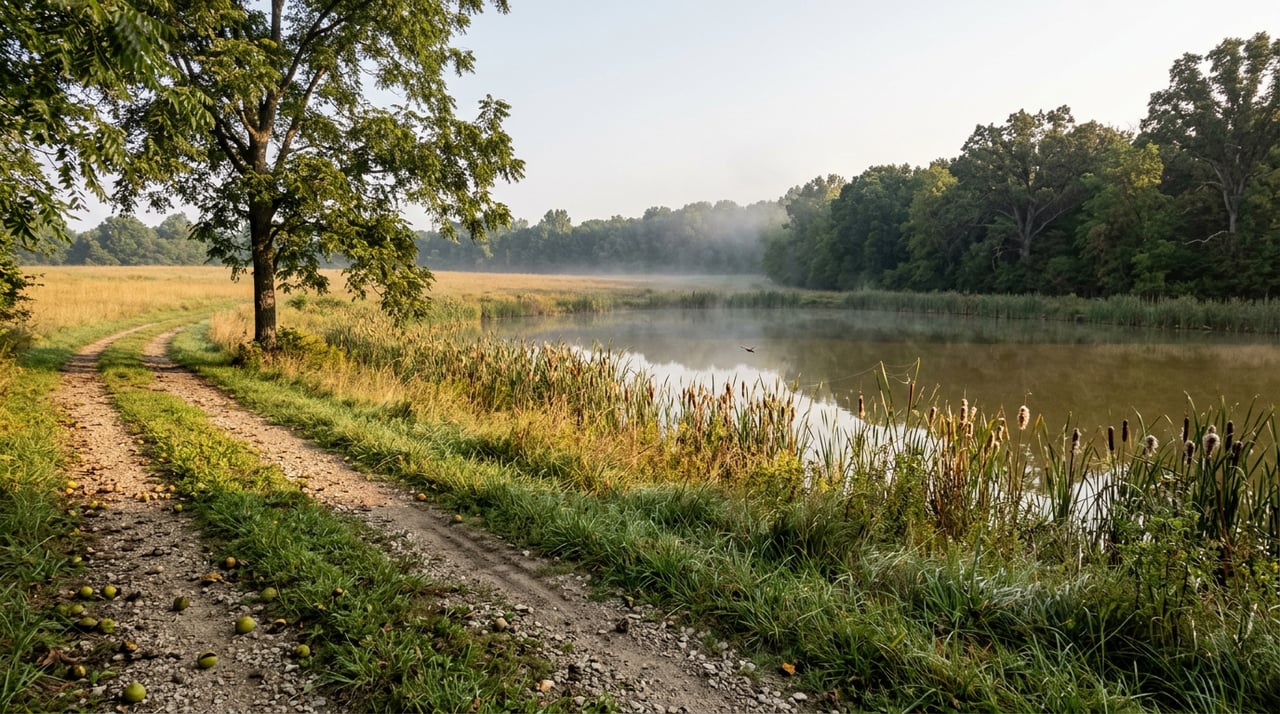
There is a 23.46-acre property on County Road 275 E right now, a few minutes outside New Castle, with a private drive winding past a roughly 2.5-acre pond toward a build site that reads as part homestead, part weekend retreat. A few miles the other direction, toward Muncie, an 85-acre working orchard is on the market, described in its own listing as blending commercial viability with agricultural potential. Both of these tracts sit in Henry County. Both get folded into the same headline number when someone searches "land for sale near New Castle" and lands on a per-acre average.
They should not be treated as the same market. And the data backs that up.
One County, Two Very Different Numbers
Pull up land pricing for Henry County on two different marketplaces this summer and you will get two different answers that are not close. One site puts the countywide median at $16,607 an acre. Another, tracking a smaller set of current listings, shows an average cost to buy of $42,042 an acre. Narrow that second site down to farms specifically and the average drops to $32,940 an acre.
None of those numbers is wrong. They are measuring different populations of land. A median pulls from every parcel advertised, including large row-crop tracts that push the per-acre price down simply because acreage and price don't scale in a straight line. An average built from a smaller, currently-active pool of listings can skew heavily toward smaller, buildable, water-featured tracts, the kind that price more like a homesite than a farm. When a buyer walks into a Henry County land conversation quoting a single "market average," they are usually quoting whichever number their search happened to surface first, not the number that applies to the parcel they actually want.
Why the Gap Exists
The clearest explanation for the spread doesn't come from a listing site. It comes from Purdue's own Farmland Value and Cash Rents Survey, the benchmark that farm lenders and appraisers across Indiana use every year. Purdue's 2025 numbers show two segments of the land market moving in opposite directions.
| Land type (2025) | Value per acre | Change from 2024 |
|---|---|---|
| Top-quality farmland | $14,826 | +3.0% |
| Average-quality farmland | $12,359 | +5.4% |
| Poor-quality farmland | $9,819 | +7.6% |
| Recreational land | $9,542 | +18.0% |
Top-quality tillable ground, the kind an operator buys to run a combine over, gained a modest 3 percent. Recreational land, the kind that supports a pond, timber, hunting access, or a homesite with some privacy, jumped 18 percent in a single year. That is not a rounding difference. It means the buyer chasing a small, pretty, buildable tract near New Castle is competing in a segment of the market that heated up six times faster than the segment a straight row-crop investor is shopping in.
The 23.46-acre parcel on County Road 275 E, with its pond and private drive, sits squarely in that faster-moving recreational category. The 85-acre orchard tract sits closer to the working-farm category, priced against income potential and soil productivity rather than against how good the view is from the porch you'd build.
A buyer who quotes one countywide average to both sellers is going to misjudge at least one of those negotiations.
What This Means If You're Actually Bidding on Ground Here
If you are looking at 10 to 20 acres within a short drive of New Castle for a homesite, a hobby operation, or a weekend property, you are shopping in the part of the Henry County market that Purdue's data says is appreciating fastest and drawing the most competition. Expect more interest per listing, and expect the per-acre price to land well above whatever countywide median gets quoted to you in casual conversation.
If you are looking at a larger straight agricultural tract, 60, 80, 100 acres of tillable ground, you are in a market growing more slowly and more predictably. Purdue's national context helps here too: U.S. farm real estate averaged $4,350 an acre in 2025 and U.S. cropland averaged $5,830 an acre, according to the USDA's Land Values 2025 Summary, so Indiana ground, and Henry County ground within it, prices well above the national baseline regardless of which segment you're in. Indiana's statewide farm real estate value climbed from $6,700 an acre in 2021 to $8,850 an acre in 2025, a 32 percent gain over four years, according to that same USDA data referenced in Purdue's 2026 outlook. The Federal Reserve Bank of Chicago reported Indiana farmland values up 6 percent year over year through 2025, while noting prices were largely flat quarter to quarter, a signal the broad farm market may be settling into a steadier pace even while recreational parcels keep climbing.
The Acreage Number Doesn't Guarantee You Can Build
Here is the part that catches buyers off guard after the offer is already in. Owning 10 or 15 acres in Henry County does not automatically mean you can put a house on it.
Henry County's Rural Residential zoning caps density at one dwelling per 20 acres for any property relying on an individual sewage system, and the county's development code sets a minimum lot size of 1.5 acres in that district unless the Henry County Health Department requires more room for proper sewerage. That last clause matters more than the acreage on the deed. Whether a parcel can actually support a septic system depends on a soil evaluation, not on how many acres you're buying. Indiana's on-site sewage rule requires a certified soil scientist to test the site before a septic permit gets issued, and the Henry County Health Department oversees that permitting and the final inspection. A pretty 10-acre tract with poor percolation can end up limited to a smaller home than the buyer planned, or in rare cases, unable to support a septic system at all.
This is exactly where a contractor's eye earns its keep before an offer goes in, not after. Confirming soil viability, well access, and broadband before you're under contract costs a phone call. Confirming it after closing costs a redesign.
Where the Supply Actually Sits
Of the land currently advertised across Henry County, New Castle itself accounts for more of it than any other part of the county, and the total inventory adds up to roughly 2,000 acres with a combined market value near $44 million, ranking Henry County 38th among Indiana's 92 counties for land currently advertised for sale. That concentration around New Castle is good news for a buyer who wants smaller, in-close acreage rather than a remote tract an hour from town. It also means the recreational-tier competition described above is happening in the same geography most buyers are already searching, not somewhere else in the county.
FAQ
Does more acreage always mean a lower price per acre in Henry County? Not necessarily, and that is the core of the confusion. Small, recreational, or homesite-ready parcels near town have been appreciating faster than large tillable tracts, so a smaller parcel can carry a higher per-acre price than a much larger farm.
Can I build a house on any parcel over an acre or two? Only if the soil supports a septic system and the parcel meets Henry County's zoning minimums for its district. A soil evaluation before you make an offer is the only way to know for certain.
Is recreational land in Henry County a good investment right now? Purdue's 2025 survey shows recreational land values rising faster than any other land category tracked, up 18 percent in a single year. That trend reflects demand, not a guarantee of future appreciation, and local supply and access still drive the real price on any individual parcel.
If you are weighing a specific tract near New Castle, whether it is a pond-and-timber homesite or a working acreage with income potential, we would rather walk it with you before you write an offer than after. Mike McKown's contractor background means a soil or building-feasibility question gets answered on the spot instead of guessed at. Reach out to The McKown Team and let's look at the actual parcel, not just the county average.