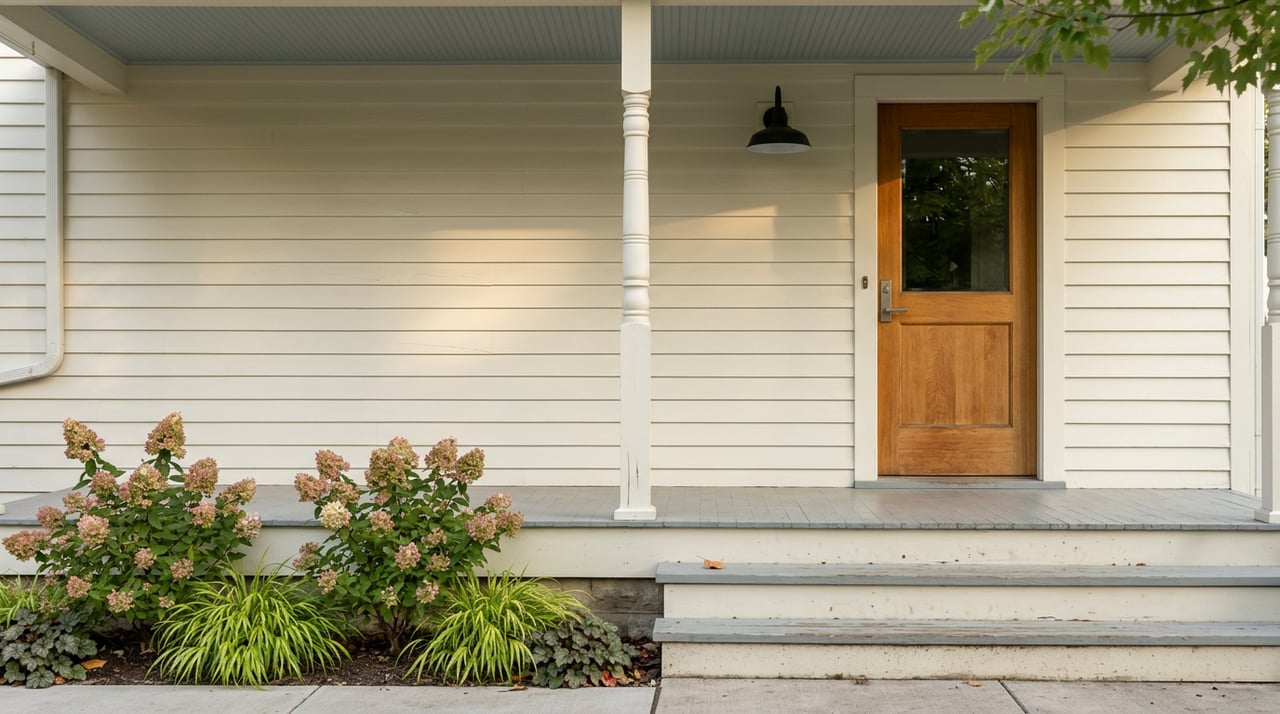
Walk the blocks west of Anderson's downtown and the housing stock tells you the city's story before any listing sheet does. Italianate cornices, American Foursquares, Dutch Colonials, bungalows with tapered porch columns. The West Central Historic District was listed in the National Register of Historic Places in 1984, and both it and the West 8th Street district still trade hands regularly on the open market.
If you own one of these houses, or any Anderson home built before 1978, you are not really selling into the same market as a 1990s ranch on the east side. You are selling into a market where a single federal rule and a single state form quietly determine what your listing price should be. Most sellers set the price first and discover the rule later. That is the wrong order.
The mechanic hiding under the median
Redfin put Anderson's median sale price at $156,000 in November 2025, with homes moving after a median of 26 days. Zillow's home value index runs lower, closer to $130,558 as of mid-2026. Two different numbers, one shared blind spot: neither tells you what condition tier your house sits in, and in Anderson, condition tier is doing most of the pricing work.
Here is why. Roughly 22% of Anderson's rental units alone were built in 1939 or earlier, and the owner-occupied stock skews similarly old in the districts closest to downtown. Once a house is pre-1978, a specific chain of obligations kicks in the moment you list it. Those obligations quietly raise the cost of every repair a buyer's inspector is going to ask for. Sellers who price against the median without accounting for that chain end up giving the difference back at the inspection response.
What Indiana's disclosure form forces into daylight
Indiana uses the Seller's Residential Real Estate Sales Disclosure, State Form 46234, and it is not a rushed formality. The seller discloses actual current knowledge on about 60 features of the home, memorializes that knowledge in writing, and is required to complete the form before accepting an offer from a buyer. The seller must also sign the form again at closing to attest the statements are still true and that the property is in the same or better condition than when the form was completed.
That second signature is the one that matters for older houses. It converts the disclosure from a one-time snapshot into a running warranty across the entire escrow window. If your water heater fails in week three, that has to be updated. If a heavy August rain reveals a basement seep you had not seen in years, that has to be updated too.
The form organizes questions around what you actually know about:
- Foundation, basement or crawlspace, floors, walls, ceilings, roof, attic, windows, and doors
- Electrical, plumbing, heating and cooling, water heater, sump pump, water softener
- Known environmental issues including mold, radon, asbestos, methamphetamine contamination, and lead-based paint
- Flood zone status, drainage, settling or expansive soils, and whether the property sits in an airport noise zone
- HOA membership and governing documents, encroachments, and residential zoning
Even a past issue, like a basement leak five years ago, should be listed if you know about it. Indiana's standard is "current actual knowledge," which sounds forgiving. It is not. Sellers are not required to get a home inspection before completing the form, and most states only require disclosure of issues the seller already knows about. Selling as-is does not remove the requirement either, and neither does inheriting the house from a parent who lived there for forty years.
The rule that turns a $300 repair into a $3,000 repair
This is the piece almost no online guide connects to pricing. The federal Renovation, Repair and Painting rule applies to any pre-1978 house. EPA requires that RRP projects that disturb lead-based paint in homes built before 1978 be performed by lead-safe certified contractors, and while the rule does not apply to homeowners doing projects in their own homes, it does apply if you buy, renovate, and sell homes for profit. For sellers preparing to list, the practical effect is that any licensed contractor you hire to fix a rotted sill, patch a porch column, or replace a chewed-up window casing has to work under RRP protocols.
The state assumption is unforgiving on this point. If a lead inspection has not been completed, the rule assumes that all paint in a pre-1978 house is leaded. And once the assumption is on, so is the cost. Lead-safe practices add labor, containment, disposal, and documentation to jobs that would otherwise take a morning.
The likelihood that your home contains lead-based paint is higher if it was painted before 1978. The EPA estimates that 87 percent of homes built before 1940 contain lead-based paint, while only 24 percent of homes built between 1960 and 1977 do.
For a West Central Foursquare, that 87% figure is your working assumption unless you pay for testing. For a 1965 ranch on the north side, the odds are closer to a coin flip. The difference matters because inspection response letters treat "scrape and repaint" and "abate and repaint" as the same request in the same paragraph, but the cost curve underneath them is not the same at all.
There is a second cost layer for buyers who plan to finance with FHA or VA. Peeling exterior paint on a pre-1978 house is a common condition of loan approval. That means the request will get made. It also means "we will offer a credit at closing" is often not an acceptable answer, because the lender wants the work done before funding. The negotiation stops being about money and starts being about calendar.
The historic-district layer most sellers underestimate
If your house sits in West Central or the West 8th Street Historic District, you are selling into a design-review overlay on top of everything above. The Anderson Historical and Cultural Preservation Commission was established in the early 1980s to preserve, promote, and develop the historical and cultural resources of Anderson, and the commission reviews all exterior modifications made to structures and sites in the districts. Historic guidelines were created in 1995 to help protect and maintain those resources.
Practical translation for a pre-listing project list: replacing a rotted wood porch with composite decking, swapping original double-hung windows for vinyl, or re-siding in a modern profile are all conversations you have to have with the commission before the work happens, not after. That reshapes your prep budget. It also, honestly, protects your price. The West Central Historic District remains one of the city's best collections of late-nineteenth and early-twentieth-century residential architecture, including Queen Anne, Italianate, Colonial Revival, and Classical Revival examples, and buyers who seek out that inventory are paying for character, not for aluminum trim.
The distinct styles matter too. There are less than 200 structures within the West Central district, which represent significant Italianate styles, Bungalow, Dutch Colonial, American Foursquare, and Shingle, just to mention a few. Direct comparables are scarce. A generic per-square-foot average will lead you astray on either side.
Reading the market with this in mind
Zoom out to the state number for a moment. In 2026, mortgage rates have run about fifty basis points below 2025, boosting statewide home sales and new listings to their highest totals through the first six months of the year since 2022. More buyers are shopping. But inventory is thin: the average monthly inventory of existing homes on the market increased nearly 20% year-over-year, yet the state's months supply of inventory has topped out at just 2.8 months, well short of the six-month benchmark of a balanced market.
That is the tailwind. The headwind for older Anderson homes is on the insurance side. Carriers have tightened roof-age guidelines, and a roof past 15 to 20 years can trigger premium spikes, which is exactly why sophisticated buyers now ask about roof age before writing an offer, not after inspection. Combine that with the RRP cost floor on exterior paintwork and the picture clarifies: a well-prepped older Anderson home priced honestly against its condition will move. A rough one priced against the median will sit, drop, and eventually sell for less than a clean-eyed prep would have netted.
A sequence that fits older Anderson homes
For sellers of a pre-1978 house, the sequence that consistently produces the cleanest transaction looks like this:
- Order a pre-listing inspection before you order comparative pricing. The inspection report becomes the input to both your disclosure form and your list price, not an afterthought.
- Decide on lead testing based on the age band. Pre-1940 houses almost always warrant XRF testing before quoting exterior paint work. Post-1960 houses often do not.
- Get RRP-certified bids on any exterior scraping, siding repair, or window trim work. Compare against the cost of pricing the house at a level that lets the buyer handle it.
- If you sit in a historic district, submit exterior repair plans to the commission before scheduling the contractor.
- Complete State Form 46234 with the pre-listing inspection open on the table, and update it whenever conditions change through closing.
- Price against buildings in similar condition and style, not against the citywide median.
FAQ
Do I have to fix everything I disclose? No. Disclosure and repair are separate decisions. The form asks what you know, not what you have solved. Many older Anderson homes sell with acknowledged wear because the price already reflects it.
Can I sell as-is and skip Form 46234? Not if the property is a one-to-four-unit residential sale. Almost all sales of 1 to 4 unit residential property require the Seller's Residential Real Estate Sales Disclosure, delivered to the buyer before their offer is accepted. Only a few transfers are exempt. Selling as-is does not remove the disclosure requirement.
What if I inherited the house and never lived in it? The seller is required to make an earnest effort to complete this form even if he or she has never lived at the property. There is a "Do Not Know" column for a reason. Estate sales usually rely on that column, paired with a pre-listing inspection so buyers still see a full picture.
Older houses in Anderson reward sellers who prepare them the way they were built: with attention and honest craft. If you are thinking about listing a home in West Central, West 8th Street, or anywhere else in the older core, The McKown Team can walk the property with you, sort the repair choices from the disclosure choices, and price the house against what it actually is. Contact us when you are ready to talk it through.